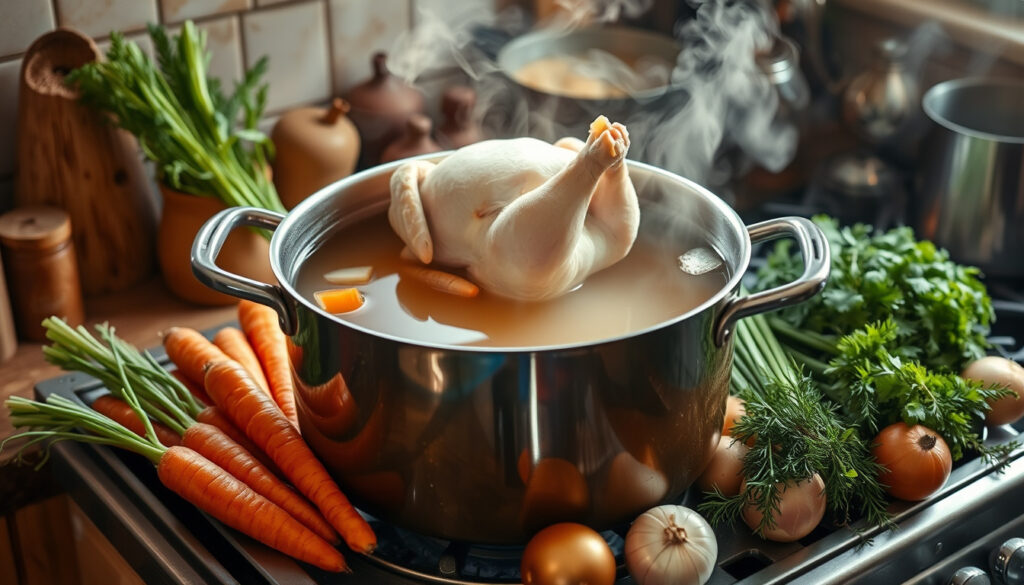
How to Make Chicken Broth from Scratch
The moment you crack open a jar of real chicken broth made from scratch, you understand why people bother. That deep, golden liquid is built from bones and aromatics over hours, not from a powder packet in 5 minutes. Whether you call it stock or broth matters less than understanding what goes into making it right—and homemade happens to be naturally gluten-free, cheap, and far more flavorful than anything from a carton.
Prep Time: 15 minutes · Cook Time: 3–4 hours (stovetop) · Yield: 4 liters · Simmer Method: Low heat
Quick snapshot
- Stock uses bones; broth uses meat and bones — The Marching Apron
- Homemade broth is naturally gluten-free — The Gluten Free Blogger
- Stock jells when cooled due to collagen — The Marching Apron
- Exact mineral extraction amounts from adding vinegar
- Optimal FODMAP tolerance varies individually
- Stovetop: 45 min simmer — Noshtastic
- Instant Pot: 25 min pressure — Noshtastic
- Slow cooker low: 6–8 hours — Noshtastic
- Strain, cool, and freeze for up to 3 months
- Use as base for soups, risottos, or braising liquid
The following table summarizes how four common cooking methods compare across key parameters.
| Parameter | Stovetop Broth | Instant Pot | Slow Cooker (Low) | Bone Broth |
|---|---|---|---|---|
| Primary protein | Whole chicken or breasts | Whole chicken | Whole chicken or carcass | Bones only |
| Cook time | 45 minutes simmer | 25 minutes high pressure | 6–8 hours | 6–72 hours |
| Water volume | 4–6 liters | 6 quarts | Cover bones completely | 3–4 quarts |
| Yield | Several quarts | 9 cups (6qt pot) | Several quarts | Concentrated base |
| Typical seasoning | Light initial salt | Bay leaf, peppercorns | Salt and pepper | Minimal salt |
How do you make chicken broth?
The classic stovetop method rewards patience. You start by browning chicken pieces with onions, garlic, celery, and carrots in oil—this builds flavor before any water touches the pot. Once everything is golden, you add cold water, bring it to a boil, then immediately reduce to a gentle simmer. Skim off the foam that rises during the first 10–15 minutes to keep the liquid clear. After that, let it cook undisturbed for at least 45 minutes, though longer yields better flavor (Noshtastic, recipe database).
Basic ingredients
- 1 whole chicken (2–3 lbs) or 1–2/3 lbs chicken breasts (Gluten Free Recipe Box)
- Onions, celery, carrots (the classic mirepoix)
- Bay leaf, thyme, peppercorns
- 12 cups cold water (Gluten Free Recipe Box)
- Apple cider vinegar (optional — draws minerals from bones)
Step-by-step stovetop method
- Cut chicken breasts into chunks and brown in butter or oil for about 20 minutes (Gluten Free Recipe Box)
- Add roughly chopped onions, celery, and carrots; cook until softened
- Pour in 12 cups cold water and bring to a boil
- Skim foam as it rises, then reduce to low heat
- Add bay leaf, thyme, and peppercorns
- Simmer uncovered for 45 minutes to 1+ hour (Noshtastic)
- Strain through a fine mesh sieve and cool before storing
How to make chicken broth from scratch?
Whether you prefer whole chicken or bones, the principle stays the same: low heat, long time, and minimal disturbance. Bones deliver more collagen (the stuff that makes stock gelatinous when cold), while meat-heavy batches produce a lighter broth suited for immediate sipping (The Marching Apron, gluten-free cooking blog). For an extra-rich stock, roast the bones at 400°F for 30 minutes before simmering—this caramelization adds a nutty depth the raw method can’t match (Cathy’s Gluten Free).
Using bones or whole chicken
A rotisserie chicken carcass makes surprisingly good stock. Pick the meat for dinner, then crack the leftover bones into a pot, add vegetables, cover with water, and simmer. Sources at Hot Pan Kitchen confirm this approach yields a flavorful result with almost zero effort (Hot Pan Kitchen). For true bone broth—popular for gut health—you’ll want to simmer bones with a splash of vinegar for 6 to 72 hours (Cathy’s Gluten Free). The vinegar helps pull minerals like calcium and magnesium from the bones (Feed Me Phoebe, gut-health recipes).
Vegetable additions
Onions, celery, and carrots form the standard aromatic base. You can add leeks (if tolerating FODMAPs), parsnips, or garlic, but avoid starchy vegetables like potatoes that cloud the broth. The Dutch oven method packs everything in, covers with 3 quarts water, and lets it go for 3–8 hours (GFF Magazine, gluten-free publication). Longer simmering—whether 2–3 hours uncovered (The Marching Apron) or up to 8 hours (GFF Magazine)—results in a richer, more golden color and deeper flavor extraction.
Bone broth wins on nutrition but takes days. If you’re cooking for a weeknight soup, a 45-minute stovetop broth hits the table tonight while bone broth rewards weekend meal preppers willing to plan ahead.
Is chicken stock the same as chicken broth?
Not quite, though the terms get swapped constantly in grocery stores and recipes. Stock comes primarily from bones, which release collagen during long cooking and make the liquid jell when refrigerated. Broth uses more meat and cooks faster, producing a lighter, more immediately flavorful liquid (The Marching Apron). The practical difference matters in cooking: stock forms a better base for sauces and gravies, while broth works well as a direct sipping soup or risotto liquid.
Key differences
The table below highlights the main ingredient, texture, timing, and use-case differences between these two preparations.
| Factor | Stock | Broth |
|---|---|---|
| Primary ingredient | Bones | Meat + bones |
| Texture when cooled | Gelatinous (jells) | Liquid |
| Typical cook time | 2–72 hours | 45 min – 4 hours |
| Flavor intensity | Deep, rich | Lighter, immediate |
| Use case | Sauces, gravies, base cooking | Soups, sipping, grains |
When to use each
Commercial versions differ very little in taste—manufacturers blur the line for marketing. Homemade stock, however, behaves differently because of the collagen. The gelatinous texture when cold is your proof that you’ve extracted real collagen from bones (The Marching Apron). You can dilute stock with water to substitute for broth in recipes if you want a lighter result (The Marching Apron). For the reverse—stretching broth to act like stock—you’d need to simmer it longer to reduce and concentrate.
The jelling property isn’t just a texture curiosity—it’s your visual confirmation that collagen has leached from the bones. A batch that stays liquid after cooling used too much meat, too little bone, or cooked too briefly.
How do you make chicken bone broth?
Bone broth follows the same process as stock but demands more commitment. The extended cooking time—typically 6 to 72 hours—breaks down connective tissue completely, releasing amino acids like glycine and proline that simpler broths don’t extract (Cathy’s Gluten Free, gluten-free cooking blog). This is why bone broth has become popular in gut-health circles, though the evidence for specific digestive benefits remains largely anecdotal.
Ingredients list
- Chicken bones (2–3 lbs)
- Water to cover (3–4 quarts)
- 1 tablespoon apple cider vinegar (Feed Me Phoebe)
- 1 teaspoon salt (Cathy’s Gluten Free)
- Carrots, celery, onions (optional)
Simmering instructions
Add vinegar to the water before heating—this acid environment starts pulling minerals from the bones before the pot even boils. Bring to a gentle simmer, skimming any foam, then maintain low heat for at least 6 hours. The minimum worth aiming for is 12 hours; beyond 24 hours, returns diminish sharply. Cathy’s Gluten Free describes stock turning golden brown after several hours as a visual cue that flavor is developing (Cathy’s Gluten Free). Strain through a fine mesh sieve, cool completely, and store in freezer-safe containers for up to 3 months (Feed Me Phoebe, gut-healing recipes).
Is chicken broth gluten-free?
Plain homemade chicken broth made from chicken, vegetables, water, and herbs is naturally and completely gluten-free (The Gluten Free Blogger, gluten-free recipe blog). Store-bought versions require caution because some manufacturers add wheat-based flavorings or use shared equipment. Always check the label for hidden gluten sources, especially in “natural flavors” or “spice blends” (Gluten Free Recipe Box).
For celiacs
People with celiac disease or gluten sensitivity can safely consume homemade chicken broth as long as all ingredients are verified gluten-free (The Gluten Free Blogger). The advantage of homemade is absolute control—you know exactly what went into the pot. Commercial broths, even those labeled “gluten-free,” can have cross-contamination risks depending on the manufacturing facility.
Health uses like IBS
Bone broth in particular has gained traction as a gut-healing food for irritable bowel syndrome, though human trials are limited. A low-FODMAP version using chicken wings, carrots, and herbs avoids common trigger foods (Feed Me Phoebe, low-FODMAP recipe blog). The theory is that the gelatin and amino acids may help line the digestive tract, but exactly how much you’d need to consume for benefit remains unclear without controlled studies.
Homemade stock lets you skip salt entirely initially, adding only what you need for each dish. This matters for anyone watching sodium intake—commercial broths often contain 500–900 mg sodium per cup, while homemade gives you a clean zero until you season it yourself (GFF Magazine).
How to make chicken broth in an Instant Pot or slow cooker
Modern appliances compress the timeline without sacrificing the essence of the process. The Instant Pot finishes chicken broth in 25 minutes of high-pressure cooking (Noshtastic, recipe database)—essentially achieving in minutes what a stovetop takes hours to accomplish. The slow cooker takes the opposite approach: set it before bed or before work, and come back 6–8 hours later to find perfectly cooked broth (Noshtastic).
- Instant Pot: Place whole chicken, vegetables, bay leaf, and peppercorns inside. Seal, set to high pressure for 25 minutes, then natural release. A 6-quart Instant Pot yields approximately 9 cups (Noshtastic)
- Slow cooker high: Cook whole chicken with vegetables on high for 3.5–4.5 hours (Noshtastic)
- Slow cooker low: Same ingredients, set to low for 6–8 hours (Noshtastic)
- Slow cooker stock from carcass: Hot Pan Kitchen recommends leftover rotisserie chicken bones with chopped vegetables and seasonings for a hands-off approach (Hot Pan Kitchen)
Related reading: how to make chicken broth in Instant Pot, slow cooker or stovetop · homemade chicken broth using chicken breasts
While broth cooks quicker with meat, the neighboring chicken stock recipe simmers bones longer for that signature gelatinous body many soups crave.
Frequently asked questions
How to make chicken broth from bones?
Place bones in a pot, cover with water, add 1 tablespoon apple cider vinegar, and simmer for 6–72 hours. Strain before using. For better flavor, roast bones at 400°F for 30 minutes first.
How to make chicken broth quick?
Use an Instant Pot and pressure cook for 25 minutes at high pressure. You can also use the high setting on a slow cooker for 3.5–4.5 hours, or start with a pre-cooked rotisserie chicken carcass to skip the initial browning step entirely.
Can I use water as chicken broth?
Water alone has no flavor, so you need to build broth from chicken and aromatics. However, you can substitute broth for water in recipes—you’d use more seasoning in the dish rather than relying on the liquid to carry flavor.
How to make chicken broth for baby?
Use organic chicken and vegetables without added salt. Simmer for at least 2 hours to extract minerals, strain very finely, and cool to lukewarm. Start with small amounts and check for any allergic reactions to common triggers like celery.
How to make chicken broth for ramen?
Ramen broth benefits from long simmering (at least 4 hours) to develop richness. Add soy sauce or tamari near the end for umami depth. Some cooks add kombu (dried kelp) for additional mineral content, though this introduces marine flavors different from Western-style broth.
What broth is good for IBS?
A low-FODMAP chicken broth using chicken wings, carrots, and herbs avoids common IBS triggers like onion and garlic. Bone broth may help gut lining due to its gelatin content, but individual tolerance varies significantly.
Can celiacs have chicken stock?
Plain homemade chicken stock is gluten-free and safe for celiacs. Commercial stocks require careful label reading because some contain wheat-based ingredients or are processed in facilities that handle gluten-containing products.
What experts say
“Nothing beats homemade chicken broth made from scratch!”
— Noshtastic (recipe author)
“The longer this gluten-free homemade chicken stock simmers, the richer the flavor will be.”
— GFF Magazine (gluten-free food publication)
“Homemade bone broth or soup stock tastes lovely, is very good for you, and is easy to make!”
— Cathy’s Gluten Free (gluten-free cooking blog)
For home cooks with dietary restrictions or a budget to stretch, homemade chicken broth solves multiple problems at once. It gives celiac-safe cooks a foundational ingredient that store-bought versions can’t guarantee, lets sodium-conscious cooks season exactly to their own taste, and turns what would otherwise be food waste into something valuable. Whether you choose the stovetop method for maximum control, the Instant Pot for speed, or the slow cooker for hands-off convenience, the core principle remains constant: low heat, enough time, and a few simple ingredients yield something far better than anything you can buy in a carton.
More related posts
 Freezing Rain Warning: Meaning, Alerts & Safety Guide
 How Many Days Until 2026? Countdown & Dates
 47 USD to CAD: Current Live Exchange Rate Converter
 Dallas Mavericks vs Milwaukee Bucks Match Player Stats
 Hottest Pepper in the World: Pepper X 2.69M SHU (2026)
 Free Dice Monopoly Go: Daily Links, Tips & Rewards
 100 EUR to CAD: Exchange Rate, Fees & Conversion Guide
 1 oz to Grams: 28.35g Exact + Troy Gold Ounce Guide
