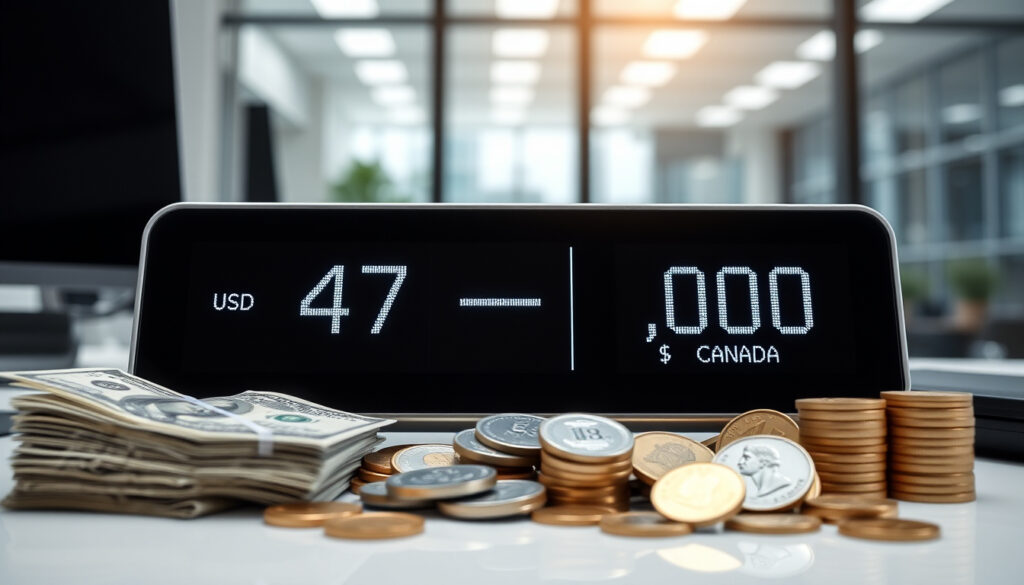
47 USD to CAD: Current Live Exchange Rate Converter
With 47 USD in hand and the Canadian dollar under pressure since October 2024, knowing the current conversion rate matters more than most people realize — the difference between platforms can cost you nearly a dollar on a single transaction. This guide walks through the current 47 USD to CAD conversion, explains why the loonie has weakened against the greenback, and shows you exactly how to get the most accurate rate when you need to convert.
47 USD to CAD: 65.61012 CAD · 1 USD to CAD: Live exchange rate · 50 USD to CAD: Conversion via Wise · 100 USD to CAD: Xe converter · CAD to USD reverse: Available on Xe
Quick snapshot
- 47 USD = 65.61012 CAD on 2025-10-28 (Myfin.us)
- USD/CAD at 1.37 at start of 2025 (Morningstar)
- CAD declined since October 2024 (Bank of Canada)
- Exact live rate as of today (platforms vary)
- Whether CAD recovers to 0.75 USD this year
- Impact of future Fed rate decisions
- CAD below 0.70 USD in January 2016 (Hill Notes)
- CAD/USD started 2025 at 1.37, moved to 1.36 by Feb 20 (Morningstar)
- Last 30-day USD/CAD high: 1.3943 (Wise)
- Loonie rebound reportedly possible in H2 2025 (Morningstar)
- CAD forecast targets 0.75 USD per CAD by year-end (Morningstar)
Three verified data points show the 47 USD figure and rate context from multiple sources.
Verified exchange data across major platforms reveals consistent conversion values for 47 USD.
| Field | Value |
|---|---|
| 47 USD equivalent | 65.61012 CAD (Myfin.us) |
| Current mid-market rate | 1.39596 CAD per USD (Myfin.us) |
| Last 30-day high | 1.3943 (Wise) |
| Top converter | Wise.com |
| Exchange tool | Xe.com |
| CAD forecast | 0.75 USD by year-end |
How much is $1 USD to CAD?
The current mid-market rate hovers around 1.39 CAD for every US dollar, though live platforms show slight variations depending on the source and time of day. Wise lists 1 USD at 1.39 CAD, while Myfin.us reports 1.39596 CAD — a gap of roughly 0.006 that reflects normal market spread across platforms.
Live 1 USD to CAD rate
The most commonly cited rates across major converters sit in a narrow band. Xe reports 1 USD equaling 1.36 CAD, Revolut shows 1.37100 CAD, and Baystreet.ca notes the pair opening at 1.3668 with overnight range 1.3660–1.3680. That 0.03-point range may sound minor, but it adds up when converting larger amounts.
Historical USD CAD trends
Looking back, the USD/CAD pair started 2025 at 1.37 and moved to 1.36 by February 20, according to Morningstar. Five years of data show an average around 62.57 CAD for 47 USD. The last 30 days saw a high of 1.3943, and over the past week the rate shifted by -0.1922 CAD or -0.293% for the same 47 USD amount.
The pattern is clear: the pair has been drifting upward for USD holders, meaning Canadians converting dollars face a larger hill to climb than they did a few years ago.
How much is $50 USD to CAD?
For 50 US dollars, the conversion lands in the 68–69 CAD range depending on which platform you check. The mid-market math suggests roughly 69.5 CAD, but the actual amount you receive after fees falls short of that theoretical number.
50 USD to CAD converter
Using Wise‘s rate of 1.39, fifty dollars converts to approximately 69.50 CAD before fees. Myfin.us, citing a slightly higher rate, shows the equivalent for 47 USD at 65.61 CAD — extrapolating that rate to 50 USD gives a comparable figure. The gap between what the mid-market rate says and what you actually get depends entirely on which service you use.
Related 47 USD conversion
The specific 47 USD figure appears directly on Myfin.us as a dedicated conversion page, showing 65.61012 CAD as of October 28, 2025. The last 30-day high for this amount was 66.04 CAD, meaning someone converting 47 USD at the peak would have received about 73 cents more than someone converting at the week’s low point.
Platform choice matters more than timing — checking two sources before converting saves real money.
How much is $1 CAD in USD today?
The reverse calculation works the same way: one Canadian dollar converts to roughly 0.72 USD at current rates. Xe and Revolut both provide reverse conversion tools, though the exact figure depends on which rate source you use and when you check it.
CAD to USD exchange
The Bank of Canada publishes official daily exchange rates by 16:30 ET, according to Bank of Canada. That rate serves as the benchmark, but platforms like AvaTrade and OANDA factor in additional variables like interest rate differentials that move the market between official publications.
Live reverse rates
For Canadians working the other direction, the practical question is whether converting USD back to CAD makes sense now or later. Morningstar reports analysts expect the loonie to reclaim the 0.75 USD mark by year-end — a 4-cent move that would meaningfully change the math for anyone moving money across the border repeatedly.
The implication: if you can delay a CAD-to-USD conversion, waiting for even partial recovery could save you money on each transaction.
Why is USD so strong?
The US dollar has strengthened against most major currencies, and the CAD is no exception. The primary driver is the interest rate differential between the Federal Reserve and the Bank of Canada, according to OANDA. Higher US rates attract investment flows into dollar-denominated assets, pushing demand for USD higher.
Factors behind USD strength
Federal Reserve rate decisions directly strengthen USD against CAD, as noted by AvaTrade. Beyond rates, US economic indicators like unemployment and GDP data move the dollar as traders react to growth prospects. A stronger US economy justifies higher rates, which in turn draws capital away from lower-yielding currencies like the Canadian dollar.
According to Bank of Canada staff analysis, the widening interest rate differential accounts for a relatively modest share of CAD’s overall decline. Most of the depreciation stems from the foreign exchange rate risk premium — essentially, markets demanding more CAD to hold it given policy uncertainty.
USD matters overview
The USD/CAD pairing matters because it affects everything from cross-border shopping to trade balances. InterchangeFinancial notes that Bank of Canada CPI and GDP data influence CAD, but when the US economy outperforms, the dollar reflexively strengthens — and Canadian exporters feel the pinch as their goods become more expensive in US dollar terms.
The catch: USD strength isn’t permanent. As Morningstar points out, CAD strength has been driven by USD weakness in some periods, not Canada-specific events. When the Fed pivots, the math shifts quickly.
USD strength is partly cyclical — a Fed pivot could flip the dynamic, but timing that move is notoriously difficult even for professional traders.
Why is CAD so weak against USD?
The Canadian dollar has declined against the US dollar since October 2024, mostly due to rising uncertainty around trade policies, according to the Bank of Canada. That trade uncertainty factor outweighs traditional economic indicators in recent months.
Reasons for CAD weakness
Trade policy uncertainty since October 2024 has been the dominant factor, per Bank of Canada. The institution’s staff economists state that most CAD depreciation is explained by the foreign exchange rate risk premium rather than interest rate differentials alone. In plain terms, investors are demanding a discount to hold Canadian assets because they don’t like the policy environment — and that discount manifests as a weaker currency.
Commodity prices also play a role, since Canada is a major exporter of oil and other resources. Hill Notes explains that commodity prices strongly influence CAD value, and when energy prices falter, the loonie follows. Higher Canadian inflation relative to foreign markets also reduces CAD purchasing power, adding another pressure point.
Canadian Dollar low analysis
CAD has seen lows before. The currency reached below 70 US cents in January 2016 when low energy prices and a strong USD converged, according to Hill Notes. That historical precedent suggests the current weakness isn’t unprecedented, though it remains uncomfortable for anyone converting USD to CAD regularly.
None of the decline in USD/CAD was driven by made in Canada events.— Sarah Ying, Head of FX Strategy, CIBC Capital Markets (Morningstar)
The widening interest rate differential is estimated to account for a relatively modest share of the overall depreciation. Most of the depreciation is explained by the foreign exchange rate risk premium.— Bank of Canada staff economists (Bank of Canada)
How to convert USD to CAD step by step
Converting USD to CAD correctly means understanding the difference between the mid-market rate and the rate you actually receive. Here’s how to approach it.
Step 1: Check the mid-market rate
Start with the interbank or mid-market rate — the one banks use when trading with each other. Wise and Xe both show rates close to this benchmark with no markup. Multiply your USD amount by the mid-market rate to see the theoretical CAD value before fees.
Step 2: Calculate your CAD amount
At the current mid-market rate of 1.39 CAD per USD, 47 USD equals approximately 65.33 CAD. Using Myfin.us’s slightly higher rate of 1.39596, the same 47 USD converts to about 65.61 CAD — a difference of roughly 28 cents that traces to normal market spread between platforms.
Step 3: Factor in conversion fees
Banks and exchange counters typically add a 1–5% markup to the mid-market rate. AvaTrade notes that Federal Reserve interventions affect USD/CAD, and that volatility can push conversion services to widen their margins. Always ask what rate you’re getting before committing.
Step 4: Choose your conversion method
Wise offers rates closest to mid-market with transparent transfer fees. Xe and Revolut provide similar services with slightly different fee structures. Bank transfers through your institution are convenient but typically carry higher fees and less favorable rates.
Step 5: Compare before you commit
Check at least two platforms before converting. The difference between getting 64.80 CAD and 65.50 CAD for your 47 USD sounds small, but it adds up over multiple transactions or larger amounts. Bank of Canada publishes daily rates as a reference point — use them to gauge whether a platform’s offer is reasonable.
Clarity on USD/CAD: What we know vs. what remains uncertain
Recent data and analyst reports provide a reasonably clear picture of the current situation, though important questions remain.
Confirmed facts
- Live rates fluctuate daily based on market conditions
- CAD has depreciated since October 2024 due to trade policy uncertainty
- Interest rate differentials play a role but don’t explain the full decline
- Most depreciation stems from FX risk premium per Bank of Canada analysis
- Bank of Canada publishes official rates by 16:30 ET daily
What’s unclear
- Exact level of today’s live rate across all platforms
- Whether CAD genuinely recovers to 0.75 USD per CAD by year-end
- How much Fed rate decisions will shift in coming months
- Duration of trade policy uncertainty effects on CAD
The pattern: current drivers are well-documented, but the forward trajectory involves genuine uncertainty even among analysts.
Summary
Converting 47 USD to CAD right now puts you in the range of 64–66 CAD depending on platform and timing. The CAD’s weakness since October 2024 traces primarily to trade policy uncertainty, not fundamental Canadian economic weakness — a distinction that matters for anyone tracking where the currency might be headed next. Analysts project a potential rebound, but timing remains uncertain.
For cross-border buyers, travelers, and businesses moving money between the two countries, the practical takeaway is straightforward: compare at least two platforms before converting, understand that mid-market rates are theoretical benchmarks, and factor in whatever fee structure your chosen service applies on top. A few minutes of research on Wise, Xe, or the Bank of Canada converter could save you real money on each transaction. The difference between a 1.36 and 1.39 rate adds up faster than most people expect.
Bank of Canada rate publications give Canadians a free benchmark to check against — using it before every conversion puts you in control of what you receive.
Related reading: 124 USD to CAD
Nearby conversions like the 50 USD to CAD guide typically yield around 69 CAD, underscoring current USD strength against CAD.
Frequently asked questions
What is the current 47 USD to CAD rate?
The rate varies slightly by platform. Myfin.us reports 65.61012 CAD for 47 USD, while Wise’s current rate sits around 1.39 CAD per USD — extrapolating that gives approximately 65.33 CAD for 47 USD. Check a live converter for the most recent figure.
How do I convert USD to CAD?
Multiply your USD amount by the current mid-market rate (approximately 1.39), then account for any fees your conversion service adds. Use platforms like Wise, Xe, or the Bank of Canada converter as reference points before committing.
What makes the USD strong against CAD?
Higher US interest rates relative to Canada attract capital flows into USD-denominated assets, strengthening the dollar. Trade policy uncertainty has also depressed CAD, pushing the pair higher for USD holders. Bank of Canada analysis shows most CAD depreciation stems from FX risk premium rather than interest rate differentials alone.
Is CAD expected to strengthen?
Analysts reportedly expect the loonie to reclaim the 0.75 USD mark by year-end, according to Morningstar. However, this remains an projection rather than a certainty, and the timing depends on Fed policy shifts and resolution of trade uncertainty.
What is 100 USD in CAD?
At the current mid-market rate of 1.39 CAD per USD, 100 USD converts to approximately 139 CAD. Using Myfin.us’s slightly higher rate of 1.39596, the same amount equals about 139.60 CAD.
How accurate are online converters?
Major converters like Wise, Xe, and Revolut provide rates very close to the mid-market rate and update frequently throughout the day. The Bank of Canada publishes official daily rates by 16:30 ET, which serve as a reliable benchmark for comparison.
Why check multiple USD CAD sources?
Platforms vary by a few hundredths of a point on any given day, and that spread directly affects how much CAD you receive. Checking at least two sources before converting takes minutes and can mean a dollar or more difference on smaller amounts — and significantly more on larger conversions.
More related posts
 Rich Dad Poor Dad: Summary, Key Lessons, and Honest Review
 Canadian Dollar to Euro Conversion: Live CAD to EUR Rates
 Mary Shelley: Biography, Life, and Controversies
 Erika Kirk: Last Post Before Charlie’s Death, Kids, Statements
 Peter Crouch: Net Worth, Wife, Dentures, Driving Ban, Career
 Erik Menendez 2025: Parole Denied, Family and Diagnosis
 London Drugs New Westminster: Pharmacy, Electronics & More
