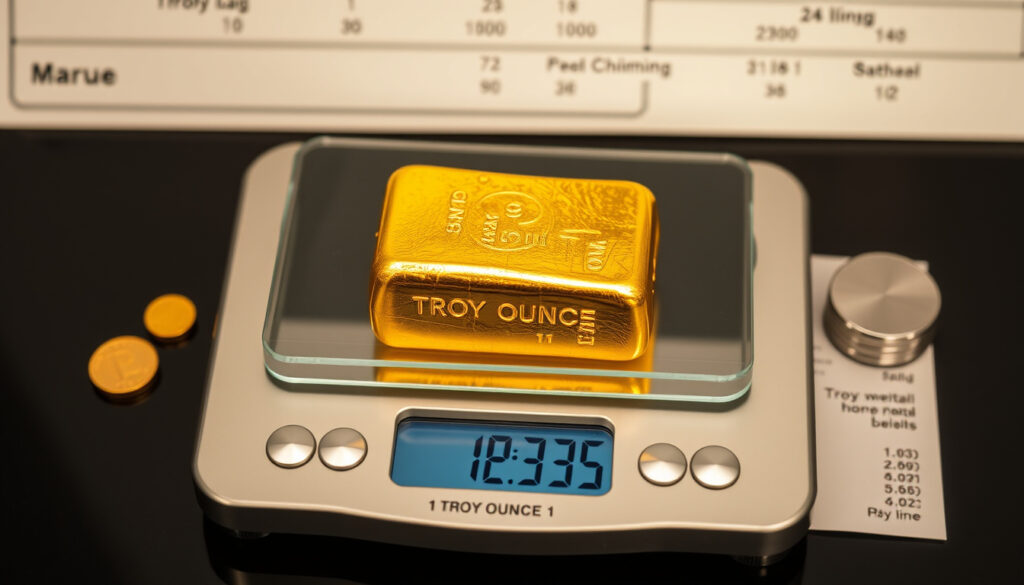
1 oz to Grams: 28.35g Exact + Troy Gold Ounce Guide
Most people never think twice about the word “ounce” — until they accidentally buy a gold bar and realize it weighs more than expected. That’s because two different systems use the same word, and the difference between them can mean the difference between a correct calculation and a costly mistake. This guide cuts through the confusion: exact gram values for both systems, where each one applies, and how to convert without a calculator.
Standard ounce: 28.34952 grams · Troy ounce (gold): 31.10348 grams · Difference: ~10% heavier for troy
Quick snapshot
- 1 avoirdupois oz = 28.34952 g (MGS Refining)
- 1 troy oz = 31.10348 g (APMEX precious metals guide)
- Troy is 9.7% heavier than avoirdupois (Wikipedia weight reference)
- Gold prices fluctuate by the second — exact gram value depends on spot price timing
- EU directive 80/181/EEC set the troy ounce approximation at 31.10 g in 1980 (Wikipedia weight reference)
- Always check which ounce a vendor uses before buying gold or silver
| Unit | Grams | Notes |
|---|---|---|
| 1 avoirdupois ounce | 28.34952 | Standard imperial ounce for cooking, everyday items |
| 1 troy ounce | 31.10348 | Precious metals standard (gold, silver, platinum) |
| Difference | 2.75396 g | Troy ounce is heavier by this amount |
| 1 avoirdupois pound | 453.592 g | 16 avoirdupois ounces per pound |
| 1 troy pound | 373.242 g | 12 troy ounces per pound — actually lighter than avoirdupois lb |
How Many Grams in an Ounce?
The answer depends entirely on which ounce you’re talking about. A standard ounce — used for food packaging, postal weights, and most everyday measurements in the United States — equals 28.34952 grams (MGS Refining). This is the avoirdupois ounce, part of the imperial system still used for non-precious commodities.
Standard avoirdupois ounce
The avoirdupois system divides its pound into 16 equal ounces, each weighing 437.5 grains (Perth Mint precious metals education). One grain equals 0.06479891 grams, which explains why the math works out to exactly 28.34952 grams per ounce (BullionVault gold guide).
Conversion formula
For avoirdupois ounces, the conversion is straightforward:
- Grams = Ounces × 28.34952
- Ounces = Grams ÷ 28.34952
This is the formula used in kitchen scales, shipping calculators, and any context where you’re weighing groceries, crafts, or parcels.
Is 1 oz 28 or 31 Grams?
This is where confusion sets in. The answer is both — and the difference matters depending on what you’re weighing. One troy ounce equals 31.10348 grams, making it approximately 9.7% heavier than the standard avoirdupois ounce (Wikipedia weight reference). The difference between the two systems is 2.754 grams (MGS Refining).
Avoirdupois vs troy differences
The two systems have different internal structures. Avoirdupois uses a decimal division: 16 ounces per pound. Troy uses a duodecimal (base-12) system: 12 ounces per pound (LPPM conversion guide). This creates a paradox — troy ounces are heavier, but troy pounds are lighter:
- 1 troy pound = 373.242 g (12 × 31.1035 g)
- 1 avoirdupois pound = 453.592 g (16 × 28.3495 g)
- The avoirdupois pound is about 21.53% heavier than the troy pound (Wikipedia weight reference)
When to use each
The rule is simple: if it glitters, it’s weighed in troy ounces. Gold, silver, platinum, and palladium are always measured in troy (BullionVault gold guide). Flour, butter, shipping weights, and body weight are always in avoirdupois. “Troy ounces are heavier than ounces, but troy pounds are lighter than pounds,” as MGS Refining puts it.
If you sell gold using the wrong ounce — thinking your 1 oz bar is 28.35 g instead of 31.10 g — you’d be undervaluing it by nearly 3 grams. Over a large stack of bullion, that error compounds into serious money.
How Many Grams in an Ounce of Gold?
Gold and all precious metals use the troy ounce as their standard unit of measurement — always (Perth Mint precious metals education). When you see gold quoted at “$1,800 per ounce,” that ounce is a troy ounce, not the standard cooking ounce. One troy ounce of gold equals 31.10348 grams with full precision (BullionVault gold guide).
Troy ounce specifics
The troy ounce is exactly 480 grains — heavier than the avoirdupois ounce at 437.5 grains (Perth Mint precious metals education). One grain is equivalent in both systems at 0.06479891 grams (BullionVault gold guide), so the math follows: 480 × 0.06479891 = 31.10348 g exactly.
Gold bar examples
Popular gold bar weights translate as follows:
- 1 troy oz gold bar = 31.10 g (the standard “1 oz” gold bar)
- 10 troy oz gold bar = 311.03 g
- 1 kilogram = 32.151 troy oz
The EU directive 80/181/EEC legally approximates the troy ounce as 31.10 grams for precious metals trading in Europe (Wikipedia weight reference). Some vendors round to 31.1 g; others use the full 31.1035 g. For large transactions, the rounding convention matters.
What this means: Always confirm the rounding convention with your dealer before large gold purchases — a 0.0035 g per ounce difference on a 100-ounce stack adds up to real money.
What is the Troy Ounce?
The troy ounce is a vestige of the medieval weighing system used at the Troyes market in France, where merchants traded precious metals using this standardized unit. Today, the precious metals industry uses the troy ounce as its basic unit of measure, regardless of whether a country has adopted metric or imperial systems (Perth Mint precious metals education).
History and definition
The troy system is based on a duodecimal (base-12) division rather than the decimal system used in avoirdupois (LPPM conversion guide). A troy ounce is exactly 480/437.5 or 192/175 avoirdupois ounces — approximately 1.09714 ounces avoirdupois or about 9.7% more (Wikipedia weight reference).
Precious metals use
Most precious metals are measured in troy ounces, while most base metals are described in avoirdupois ounces (Hero Bullion guide). The UK Weights and Measures Act of 1985 established the troy ounce as the only troy unit allowed in trade, and only for precious metals (Wikipedia weight reference). “When you see ‘ounce’ and ‘oz’ used in the context of precious metals, assume the reference is to troy ounces,” advises Perth Mint precious metals education.
The implication: Any investor who conflates the two systems risks either overpaying for gold or undervaluing their holdings by a margin that adds up fast over multiple transactions.
1 oz to Grams Calculator and Quick Conversions
You don’t need JavaScript or a web calculator — here’s how to convert any ounce value manually, plus a quick reference table for common amounts.
Step-by-step conversion
To convert ounces to grams:
- Identify which ounce type you’re using (standard or troy)
- Multiply by the correct factor: 28.34952 for avoirdupois, 31.10348 for troy
- Round to the precision you need (two decimal places is standard for gold; one for cooking)
To convert grams to troy ounces, multiply by 0.03215 (BullionByPost conversion tool). The reverse formula for troy ounces is: Grams = Troy Ounces × 31.10352185 (Metric Conversions reference).
Common multiples: 1/2 oz, 4 oz, 5 oz, 10 oz
Four avoirdupois ounces equals 113.40 grams. Here are all the key multiples:
| Ounces (avdp) | Grams | Ounces (troy) | Grams |
|---|---|---|---|
| ½ oz | 14.17 g | ½ ozt | 15.55 g |
| 1 oz | 28.35 g | 1 ozt | 31.10 g |
| 4 oz | 113.40 g | 5 ozt | 155.52 g |
| 5 oz | 141.75 g | 10 ozt | 311.03 g |
| 10 oz | 283.50 g | 100 ozt | 3,110.35 g |
For gold investors, the troy column is what matters. For cooks and shippers, the avoirdupois column is your reference. Mixing the two is the single most common source of error in ounce calculations.
Upsides
- Troy ounce is internationally standardized for gold trading
- Full precision values available: 31.10348 g exact
- Clear regulatory backing (EU directive, UK Weights & Measures Act)
- Conversion factors are mathematically fixed — no approximation error
Downsides
- Two systems with same name cause frequent confusion
- Some vendors round differently (31.1 g vs 31.1035 g)
- No visual difference between troy and avoirdupois ounces
- Cooking recipes rarely specify which ounce system they use
A troy ounce is exactly 480 grains, while an avoirdupois ounce is 437.5 grains. That’s the whole reason for the 9.7% difference — different base units that happen to share a name.
— BullionVault precious metals authority
The precious metals industry uses the troy ounce as its basic unit of measure, even in countries which have adopted the metric or imperial systems. A standard ounce equals only 28.35 grams, making the troy ounce approximately 10% heavier.
Improper listing of precious metals for sale and trade using the wrong measurement system can lead to significant financial loss when trading vast quantities.
The takeaway is clear: when someone says “ounce” in the context of gold, they’re talking about 31.10 grams — not the 28.35 grams you use at the grocery store. One troy ounce is equivalent to 1.09714 avoirdupois ounces (Hero Bullion guide), which means every gold transaction carries a built-in 9.7% premium that most people never notice. The implication: any investor who conflates the two systems risks either overpaying for gold or undervaluing their holdings by a margin that adds up fast over multiple transactions.
Related reading: 23 cm to inches · 1.7 m in feet
While 1 oz equals 28.35 grams for everyday cooking, the Avoirdupois vs Troy guide details vital troy ounce differences when valuing gold bullion.
Frequently asked questions
Is 30g equal to 1 oz?
Not exactly. 30 grams equals approximately 1.0582 avoirdupois ounces (30 ÷ 28.34952) or 0.9645 troy ounces (30 ÷ 31.10348). Neither equals precisely 1 ounce — the closest is 28.35 g for a standard ounce or 31.10 g for a troy ounce.
Is 1 oz 31.1 grams?
Yes — but only for troy ounces, which are used for gold and precious metals. One troy ounce equals 31.1035 grams, often rounded to 31.1 g for trading purposes. The standard avoirdupois ounce is only 28.35 g.
What is 1 oz of gold?
One troy ounce of gold equals 31.1035 grams. It is the standard unit for gold pricing globally, regardless of the country. Gold bars, coins, and futures contracts all use troy ounces as their base unit.
How many grams is an ounce of 24K gold?
24K gold purity doesn’t affect the weight — it still weighs the same as any troy ounce: 31.1035 grams. Purity affects value, not mass. A 1 oz gold bar could be 24K (pure) or 22K (91.67% pure), but both would weigh 31.10 g.
Why is an ounce of gold 31 grams?
Gold uses the troy system, established in medieval Europe and carried forward as the global standard for precious metals. The troy ounce (31.1035 g) predates the avoirdupois ounce (28.3495 g) and has been maintained for consistency in international gold trading.
What is 30 to 1 in ounces?
The phrase “30 to 1” typically refers to a gold-to-silver ratio, meaning one ounce of gold equals approximately 30 ounces of silver by value. This is a ratio, not a conversion between ounce types.
Ounce to ml conversion?
Ounces measure weight, not volume. One avoirdupois ounce of water equals approximately 29.57 ml, but this conversion only applies to water. For other substances, density must be factored in.
How many grams in ½ oz?
½ avoirdupois ounce = 14.17 g. ½ troy ounce = 15.55 g. The difference is 1.38 grams — small enough to miss on a kitchen scale but significant in a gold vault.
More related posts
 Colin Farrell: Family, Son’s Angelman Syndrome, Career
 Jay Cutler: NFL Career, Bodybuilding, DUI and Diabetes
 Mount Denali vs Everest: Height, Difficulty, Deaths & Naming
 Trevor Linden: Career Stats, Family, and Nickname
 Allô mon Coco Menu with Prices: Breakfast & Lunch Guide
 Dane Cook: Brother’s Sentence, Net Worth, Wife, and Career Updates
 Shirley Henderson: Age, Children, Most Famous Role & Biography
 Uniprix Circulaire Semaine Prochaine Preview & Deals
