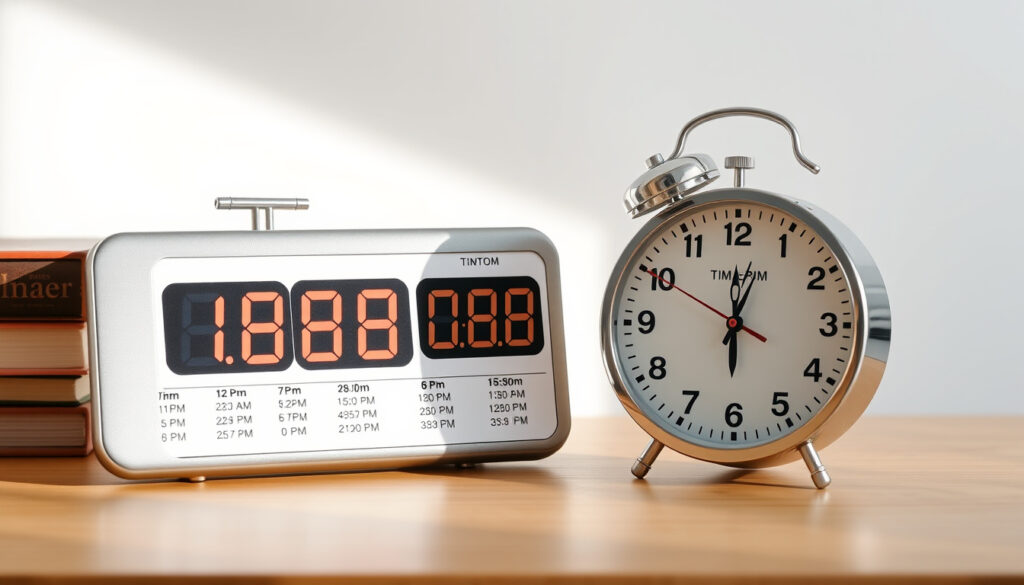
Military Time to Normal Time: Converter Chart & Guide
If you’ve ever stared at “1700” on a hospital chart or an airline ticket and wondered what on earth that means, you’re not alone. This guide walks you through converting any time from 0000 to 2359 without a calculator.
0000: 12:00 AM (Midnight) · 1200: 12:00 PM (Noon) · 1700: 5:00 PM · 2200: 10:00 PM · 2359: 11:59 PM
Quick snapshot
- Subtract 12 from hours 1300–2359 to get 1–11 PM (Khan Academy)
- 0000 or 2400 = 12:00 AM midnight (Veteran.com)
- 1200 = 12:00 PM noon (Veteran.com)
- Minutes stay identical in both formats (Log My Hours)
- Whether 2400 or 0000 is preferred varies by context — both are accepted
- Once you memorize the subtract-12 rule, every afternoon conversion takes under 5 seconds
- Reverse conversion (normal to military) uses the add-12 rule for PM times
- 17:00 (already standard PM time) = 5:00 PM — no extra “PM” (Calculator Soup)
- 20:00 = 8:00 PM; 18:00 = 6:00 PM; 22:00 = 10:00 PM (Calculator Soup)
| Military time | Standard equivalent | Rule applied |
|---|---|---|
| 0000 | 12:00 AM | Midnight |
| 0300 | 3:00 AM | Same as regular |
| 0900 | 9:00 AM | Add leading zero |
| 1200 | 12:00 PM | Noon |
| 1300 | 1:00 PM | Subtract 12 + PM |
| 1500 | 3:00 PM | Subtract 12 + PM |
| 1700 | 5:00 PM | Subtract 12 + PM |
| 1800 | 6:00 PM | Subtract 12 + PM |
| 2100 | 9:00 PM | Subtract 12 + PM |
| 2200 | 10:00 PM | Subtract 12 + PM |
How do you convert military time to normal time?
The 24-hour clock runs continuously from 0000 at midnight to 2359 at 11:59 PM, without any AM/PM designation (Veteran.com). Converting it to standard 12-hour time comes down to three straightforward cases.
Morning hours (0000–1159)
- Hours 01–12: add “AM” — stays the same as regular time
- Hours before 10: add a leading zero (e.g., 9:30 AM = 0930)
- 0000 and 2400 both mean midnight (Veteran.com)
Morning times are the easiest part of the system. For instance, 0300 in military time is simply 3:00 AM — the hour and minutes stay identical, just without the leading zero if you prefer. The same applies all the way up to 1159, which reads as 11:59 AM.
Afternoon and evening (1300–2359)
- Subtract 12 from the hour
- Append “PM” to the result
- Minutes stay exactly the same
For hours 1300 and above, the rule is to subtract 12 from the hour and add PM (Khan Academy). This gives you the 1–11 PM range covered by a 12-hour clock.
Adding PM for times after 1200
A common error is writing “5:00 PM” as “5:00 PM PM.” Once you’ve done the subtract-12 step, the result is already in 12-hour format — the PM is built in. The same goes for any military time mapping: 17:00 (already a standard PM notation) simply becomes 5:00 PM, no extra label needed.
Khan Academy’s conversion guide confirms the single-rule approach: for any hour 13 or higher, subtract 12 and add “P.M.” — nothing more complicated than that (Khan Academy).
What is 17:00 in regular time?
Step-by-step for 1700
- Military time: 1700
- Is 1700 ≥ 1200? Yes → afternoon/evening case
- Subtract 12: 17 − 12 = 5
- Result: 5:00 PM
The answer is straightforward: 1700 military time equals 5:00 PM. This holds consistently across verified conversion sources (Veteran.com, Lsoft). The minutes (00 in this case) stay exactly the same.
Related: 17:00 is not 17:00 PM
You may occasionally see “17:00 PM” in informal writing, but this is redundant notation. “5:00 PM” is the correct standard-time equivalent — the 12-hour format already implies PM for afternoon times (Calculator Soup). Calculator Soup’s conversion rules make clear that “17:00 PM” doubles up unnecessarily on the PM designation.
The pattern becomes obvious once you work through a few examples. 1700 = 5:00 PM, 1800 = 6:00 PM, 1900 = 7:00 PM — each one follows the same subtraction rule without variation.
What is 20:00 military time in normal time?
20:00 conversion
- Military time: 2000
- Is 2000 ≥ 1200? Yes → subtract 12
- 20 − 12 = 8
- Result: 8:00 PM
20:00 military time equals 8:00 PM. The calculation is identical to every other afternoon conversion: take the hour, subtract 12, and append PM. The minutes (00) stay put — there’s nothing to adjust there.
Is 20:00 8 or 9 PM?
A surprisingly common question is whether 20:00 converts to 8 PM or 9 PM. The answer is unequivocally 8:00 PM. The subtract-12 rule applies uniformly: 20 − 12 = 8 (Log My Hours). Log My Hours documents this rule consistently for all PM conversions, and it’s backed by the same arithmetic you’ll find across Khan Academy, Calculator Soup, and every other authoritative source in this guide.
If you’re ever unsure, just check whether your military hour is in the 1300s (1 PM range), 1400s (2 PM range), 1500s (3 PM range), and so on up to 2300 (11 PM range). The pattern holds: 2000 falls in the “8 PM” band.
What time is 18:00 00 00?
18:00 and similar PM times
- 18:00 → 18 − 12 = 6 → 6:00 PM
- 1800 military time = 6 PM
The notation “18:00 00 00” you sometimes see in medical or laboratory contexts means 1800 military time (18:00) — the extra zeros are simply emphasizing the full four-digit format used in clinical charting (Lsoft). The conversion follows the same subtract-12 rule: 18 − 12 = 6, giving you 6:00 PM.
Lsoft’s 24-hour clock reference confirms that 1800 maps to 6:00 PM, consistent with the verified record that “Military Time 1800 = 6:00 p.m.” The zeros after the colon simply pad out the minutes and seconds fields — not a separate time value.
Working backward, 6:00 PM in normal time converts to 1800 in military format by adding 12 to the hour (6 + 12 = 18). This reverse operation confirms the forward conversion is correct.
What is 22:00 00 00?
Late evening conversions like 21:00 and 22:00
- 21:00 → 21 − 12 = 9 → 9:00 PM
- 22:00 → 22 − 12 = 10 → 10:00 PM
22:00 military time converts to 10:00 PM, and 21:00 converts to 9:00 PM — both confirmed across verified conversion charts (Log My Hours). The same subtract-12 rule handles the entire late-evening range with no special cases.
If you’re dealing with a clinical timestamp like “22:00 00 00,” treat it exactly like standard 2200 military time. The trailing zeros again represent padded minute/second fields used in certain medical software, not additional time components. The conversion remains: 22 − 12 = 10 → 10:00 PM.
freeCodeCamp’s explanation of regional time preferences notes that most countries worldwide use the 24-hour clock, while English-speaking countries like the US prefer the 12-hour AM/PM system (freeCodeCamp). This is why military time matters so much in US medical, aviation, and military contexts — it’s the shared reference point across agencies and institutions.
Conversion steps: normal to military (reverse)
Knowing how to convert the other direction — from normal 12-hour time to military — completes the picture. The rules mirror the forward conversion but in reverse.
PM times: add 12 to the hour
- 1:00 PM → 1 + 12 = 13:00
- 5:00 PM → 5 + 12 = 17:00
- 9:00 PM → 9 + 12 = 21:00
- 12:00 PM (noon) → stays 12:00
For any PM time between 1:00 and 11:00, add 12 to the hour to get the military equivalent (Log My Hours). Noon is the one PM time that doesn’t change — 12:00 PM is already 12:00 in military format.
AM times: strip the leading designation
- 12:00 AM (midnight) → 00:00
- 9:30 AM → 09:30 (add leading zero)
- 3:00 AM → 03:00
- 1:00 AM through 11:59 AM stay the same numerically
Morning conversions require one key adjustment: midnight (12:00 AM) becomes 00:00, and times before 10:00 need a leading zero (Calculator Soup). Beyond that, 9:30 AM is 09:30, 3:00 AM is 03:00 — the numbers stay the same, just with proper zero-padding.
Harvest’s step-by-step conversion guide lays out both directions clearly, confirming that morning hours 1:00 AM to 12:59 PM are identical in both systems except for the midnight edge case and zero-padding (Harvest). Once you’ve internalized both directions, switching between formats takes only a moment.
AM times: midnight → 00:00, everything else same number, add leading zero before 10. PM times: add 12 to hour (12:00 PM stays 12:00). Minutes are never changed in either direction.
Confirmed facts
- Standard rule: subtract 12 from hours 1300–2359 and add PM
- 0000 and 2400 both represent midnight
- Minutes remain unchanged in all conversions
- Conversion charts are consistent across verified sources
- Morning hours (0000–1159) are identical in both formats
- Reverse conversion uses add-12 for PM, leading-zero for morning
Common confusions
- Thinking 12:00 AM is the same as 12:00 PM — it’s midnight vs. noon, completely different times
- Adding “PM” twice: writing “5:00 PM PM” instead of just “5:00 PM”
- Confusing 2000 (8 PM) with the 9 PM range
- Forgetting the leading zero for morning military times like 0900
“The morning hours are the same. So 1:00 a.m. is the same in both military and civilian time.”
— MilitaryTimeChart.com (Time Conversion Reference)
“Most countries prefer the 24 hour clock method, but the 12 hour clock is widely used in Latin America and English-speaking countries.”
— freeCodeCamp (Educational Platform)
For anyone working in US healthcare, aviation, or government contexts, the 24-hour clock isn’t optional — it’s the shared language that prevents errors when timing is critical. Whether you’re reading a medication schedule, an airline itinerary, or a military operations log, the conversion method is identical: identify which time range you’re in, apply the subtract-12 rule for afternoon/evening, and move on.
Related reading: 23 cm to Inches – Exact Conversion and Guide · 1.7 m in Feet – Exact Conversion and Height Comparisons
militarytimechart.com, farnorthernrc.org, emscimprovement.center, bytebloc.com
Frequently asked questions
How do I easily convert 24h to 12h time?
For times 1300–2359, subtract 12 from the hour and add PM. For times 0000–1159, add AM (morning hours stay identical). Minutes never change.
What is 10:00 in military time?
10:00 AM (morning) stays 10:00 in military format. No conversion needed — morning hours are identical in both systems. It would be written as 1000 with a leading zero.
What is 1900 military time?
1900 = 7:00 PM (19 − 12 = 7, add PM). Minutes are 00.
What is 2100 in regular time?
2100 = 9:00 PM (21 − 12 = 9, add PM).
What is 2200 military time?
2200 = 10:00 PM (22 − 12 = 10, add PM).
Why no AM/PM in military time?
The 24-hour clock runs continuously from 00:00 to 23:59, so the AM/PM designation is unnecessary. Every hour has a unique number — there’s no ambiguity about whether a given hour is morning or afternoon (Simple Wikipedia).
How do I convert normal time back to military time?
For PM times (1:00–11:00), add 12 to the hour. For AM times, keep the same number except midnight becomes 00:00, and add leading zeros before 10:00. Noon stays 12:00.
More related posts
 Juno Temple Movies and TV Shows: Complete Filmography
 Vaginal Dryness Natural Remedies: Evidence-Based Solutions
 Australia Women vs India Women Cricket Match Scorecard – 2nd ODI 122-Run Win
 All Too Well 10 Minute Lyrics: Meaning & Gyllenhaal Response
 What Is a Swap File? Purpose, How to Create, and Size Recommendations
 315 USD to CAD – Live Rate, History and Converter
 Job Job Job Sahur: Brainrot Meme, Ritual & Rarity Explained
