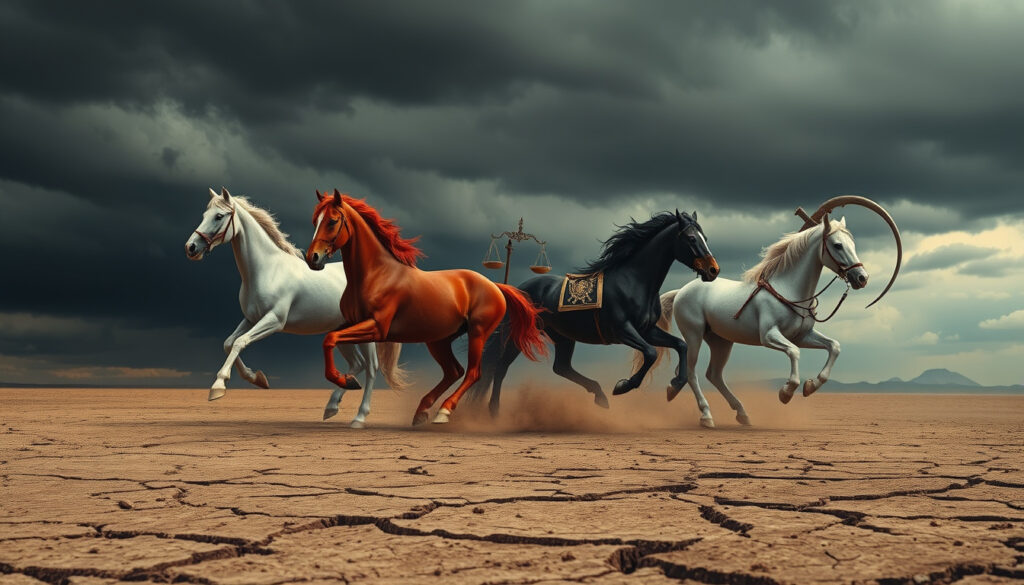
Four Horsemen of the Apocalypse: Names, Meanings, and Modern Uses
The phrase “four horsemen of the apocalypse” echoes through sermons, psychology books, and action films, but few people can name each rider or explain what they actually mean—these four figures from the Book of Revelation, released by the unsealing of the first four seals (Britannica (reference work)), carry specific symbols and colors that have been debated for centuries. Their influence extends from theology to pop culture and modern psychology.
First appearance: Book of Revelation (circa 95-96 AD) · Horsemen count: 4 distinct figures · Primary colors: White, red, black, pale · Symbols: Bow, sword, scales, Death · Pop culture adaptations: Films, manga, games, psychology metaphor
Quick snapshot
- Bow and crown (Britannica (reference work))
- Goes out conquering (David Jeremiah Blog (pastoral analysis))
- Often symbolizes Christ or Antichrist (Britannica (reference work))
- Great sword (Britannica (reference work))
- Takes peace from earth (Britannica (reference work))
- Causes conflict among people (David Jeremiah Blog (pastoral analysis))
- Scales for weighing food (Britannica (reference work))
- Economic hardship (David Jeremiah Blog (pastoral analysis))
- Reduced food supply (Barrister and Mann (literary analysis))
- Named Death (Britannica (reference work))
- Followed by Hades (Britannica (reference work))
- Kills by sword, famine, plague, and wild beasts (YouTube – Daniel Maritz Biblical Analysis)
The horsemen represent four aspects of God’s judgment that will pour out on the earth at the beginning of the Tribulation.
The Four Horsemen appear in Revelation 6:1-8 and symbolize four great cataclysmic events.
Five key facts, one pattern: each horseman pairs a color with a tool of judgment, escalating from conquest to death.
| Attribute | Value |
|---|---|
| Biblical book | Revelation (Apocalypse of John) |
| Number of seals before horsemen | First 4 of 7 seals |
| Color of first horse | White |
| Color of last horse | Pale (translucent or greenish) |
| Horsemen appear in chapter | Revelation 6:1–8 |
What are the names of the 4 Horsemen of Apocalypse?
White horse: Conquest
- Rides a white horse, holds a bow, and receives a crown (Britannica (reference work)).
- Goes out “conquering and to conquer” (Revelation 6:2).
- Interpreters differ: some see Christ, others the Antichrist (Britannica (reference work)).
Red horse: War
- Rides a fiery red horse, given a great sword (Britannica (reference work)).
- His power takes peace from the earth, making people slay each other (Britannica (reference work)).
Black horse: Famine
- Rides a black horse and holds a pair of scales (Britannica (reference work)).
- Weighs food to measure scarcity and economic hardship (David Jeremiah Blog (pastoral analysis)).
Pale horse: Death
- Rides a pale (greenish) horse, named Death, followed by Hades (Britannica (reference work)).
- Given authority over a fourth of the earth to kill with sword, famine, pestilence, and wild beasts (YouTube – Daniel Maritz Biblical Analysis).
The implication: the white horse rider remains a mystery, while the other three are clearly destructive forces.
What do the 4 horsemen represent?
Biblical symbolism of each horseman
- White horse: conquest or victorious spread of the gospel — or the counterfeit of the Antichrist (Britannica (reference work)).
- Red horse: war and bloodshed (Britannica (reference work)).
- Black horse: famine and economic injustice (David Jeremiah Blog (pastoral analysis)).
- Pale horse: death and the grave (Britannica (reference work)).
Interpretation as divine judgment
- The horsemen are agents of God’s judgment, not random destruction (David Jeremiah Blog (pastoral analysis)).
- They correspond to Jesus’ Olivet Discourse in Matthew 24:6-8 (wars, famines, earthquakes) (David Jeremiah Blog (pastoral analysis)).
Modern metaphorical usage
- John Gottman applied the term to four communication behaviors that predict divorce: criticism, contempt, defensiveness, stonewalling (Barrister and Mann (literary analysis)).
- Outside the Bible, the horsemen appear in films, manga (e.g., Chainsaw Man), and psychology as a shorthand for inevitable forces.
The same four symbols that terrified 1st-century readers now anchor a marriage-therapy framework. For Gottman, the “horsemen” are not supernatural — they are predictable behaviors that any couple can spot and reverse.
The pattern: the same symbols that warned of divine wrath now serve as a relationship diagnostic tool.
Are the four horsemen good or evil?
Divine instruments vs. destructive forces
- The horsemen act as heavenly executioners of judgment (David Jeremiah Blog (pastoral analysis)).
- They are not good in the sense of moral virtue, nor evil in the sense of rebelling against God. They carry out a predetermined plan (Britannica (reference work)).
Different theological perspectives
- Preterist view: the horsemen symbolize events of the 1st century (the Roman-Jewish war).
- Futurist view: they are literal future judgments during the Tribulation (David Jeremiah Blog (pastoral analysis)).
- Pop culture (e.g., Chainsaw Man) portrays the horsemen as villains, distinct from the biblical neutral-deputy role.
The catch: whether they are seen as neutral agents or villains depends entirely on the lens of interpretation.
Who is the 5th horseman in the Bible?
The fifth seal vision (Revelation 6:9-11)
- After the four horsemen, the fifth seal reveals the souls of martyrs under the altar (Barrister and Mann (literary analysis)).
- No rider appears — it’s a vision of slain believers asking for justice.
Modern concept of a fifth horseman
- Some interpreters propose Jesus as a fifth figure who returns after the judgments (Barrister and Mann (literary analysis)).
- Others simply say “there is no fifth horseman in the canonical Bible.” Any claim of a fifth is extra-biblical.
The fifth seal is often confused with a fifth horseman. For a careful student of Revelation, the difference is clear: seals one through four bring riders; seal five brings martyrs — not horses.
The takeaway: the fifth seal is not a rider, but a reminder of martyrdom.
Who is the most powerful 4 horsemen?
Biblical hierarchy of the four
- Death (pale horse) is the most feared because it ends life and brings Hades (Britannica (reference work)).
- No official ranking exists in scripture (David Jeremiah Blog (pastoral analysis)).
Cultural depictions of power
- In Chainsaw Man, the character called Makima (the Control Devil) is later revealed to embody Conquest — and is arguably the most dominant of the four horsemen characters in that series.
- Films often give Death the final showdown scene, reinforcing popular perception.
Four riders, one ranking pattern: Death tops every poll because it caps the sequence and escorts Hades.
| Horseman | Color | Symbol | Pop-culture power rank |
|---|---|---|---|
| Conquest | White | Bow | Often seen as the deceptive one |
| War | Red | Sword | Direct destruction |
| Famine | Black | Scales | Slow, grinding |
| Death | Pale | Death itself | Most feared |
The verdict: Death is most feared, but the Bible gives no official rank.
What is the sixth horseman?
Sixth seal events following the four
- The sixth seal (Revelation 6:12-17) features a great earthquake, cosmic disturbances, and people hiding from the wrath of God (Barrister and Mann (literary analysis)).
- No horse and rider appear in the sixth seal.
There is no sixth horseman in the Bible.
Media inventions of a sixth horseman
- Fiction occasionally adds a sixth (e.g., Pestilence as a separate figure) but that contradicts the biblical four.
The bottom line: there is no sixth horseman in scripture; any addition is fictional.
Related reading: **How Did Mr Krabs Die – Viral Meme vs SpongeBob Reality** · **Blood In Blood Out: Streaming Guide, True Story & Sequel**
For readers seeking a more detailed breakdown of the Four Horsemen, detailed breakdown of the Four Horsemen offers additional scriptural references and cultural interpretations.
Frequently Asked Questions
What does the four horsemen of the apocalypse symbolize?
They symbolize conquest, war, famine, and death as divine judgments.
Is the white horseman Jesus?
Interpreters differ; some see Christ, others the Antichrist.
Which horseman is death?
The fourth horseman on the pale horse is named Death.
Are the horsemen in Chainsaw Man based on the Bible?
Yes, the manga features characters based on the four horsemen, such as Makima as Conquest.
How does Gottman use the four horsemen?
John Gottman uses the term to describe four communication behaviors that predict divorce: criticism, contempt, defensiveness, stonewalling.
What is the four horsemen verse in the Bible?
Revelation 6:1-8.
More related posts
 Larsa Pippen: Divorce, Marcus Jordan, Kardashians & OnlyFans
 Montana Jordan: Age, Wife, Baby, Net Worth & Real Life
 Kentavious Caldwell-Pope Injury: Surgery, Rings & Career Stats
 Liza Soberano: Biography, Age, Relationship Status 2025
 Gus Fring Character Analysis: Sexuality, Death, and Morality
 Auston Matthews: Salary, Ethnicity, McDavid Comparison & More
 What I Cloned Meat? Safety, Ta te, and Labeling Fact
