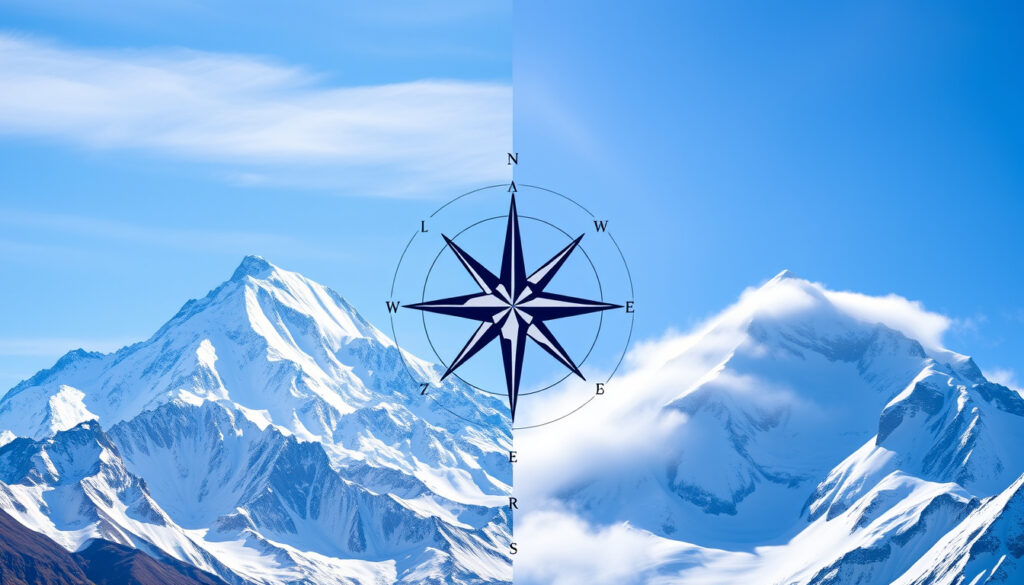
Mount Denali vs Everest: Height, Difficulty, Deaths & Naming
You’ve probably heard the debate: is Denali taller than Everest? It’s a question that trips up even experienced geography buffs, because the answer depends on how you measure a mountain. Using official measurements from the U.S. National Park Service and the 2020 China-Nepal joint survey, this article compares Denali, Everest, and Kilimanjaro across height, difficulty, and risk — so you can see exactly how the peaks stack up.
Elevation (summit): 20,310 ft (6,190 m) ·
First ascent: June 7, 1913 (Hudson Stuck, Harry Karstens, Walter Harper, Robert Tatum) ·
Climbing season: May to mid-July ·
Climbers per year: ~1,200 ·
Total deaths: 129 (as of 2024)
Quick snapshot
- Summit elevation: 20,310 ft (6,190 m) (U.S. National Park Service (official federal land manager))
- Tallest mountain in North America (U.S. National Park Service (educational materials))
- First ascent: June 7, 1913 (U.S. National Park Service (official federal land manager))
- 129 total deaths as of 2024 (U.S. National Park Service (official federal land manager))
- Whether the Trump administration will reverse the name to Mount McKinley in 2025
- Exact number of accidents in 2024 pending final report from the National Park Service
- 2015: Official name change to Denali under Obama administration
- 2024: Three climbers die in a fall near a treacherous pass
- Possible federal action to rename the mountain back to Mount McKinley
- 2025 climbing season begins in May; rangers prepare for another ~1,200 climbers
The bottom line: Denali’s base-to-summit rise of 18,000 feet makes it the tallest mountain on Earth from bottom to top, even though Everest stands higher above sea level. Climbers face extreme Arctic weather and self-sufficient expedition conditions that set Denali apart from any other peak.
Five key facts about Denali at a glance — from the first ascent party to the typical expedition length.
| Attribute | Value | Source |
|---|---|---|
| First ascent | June 7, 1913 (Hudson Stuck party) | NPS (summit survey history) |
| Typical expedition duration | 14–21 days | NPS (climbing information) |
| Summer temperature at summit | −20 to −40 °F (−29 to −40 °C) | NPS (weather data) |
| Number of climbing routes | About 20 major routes | NPS (route descriptions) |
| Annual rescue rate | ~5–10 rescue operations per year | NPS (safety page) |
Is Denali actually taller than Everest?
How base-to-summit measurement works
The standard way to measure a mountain’s height is from sea level. By that ruler, Everest stands at 29,031.7 feet (8,848.86 m) — the world’s tallest NPR (public radio news). But if you measure from the mountain’s own base, Denali wins. Denali rises from a plateau about 2,000 feet above sea level, giving it a vertical gain of roughly 18,000 feet (5,500 m) U.S. National Park Service (educational materials). Everest’s base is around 17,000 feet, so its actual rise is about 12,000 feet. In other words, Denali has a greater “relief” — the distance from base to summit — than any other mountain on Earth.
Official elevation of Denali and Everest
- Denali’s summit was resurveyed in June 2015 with modern GPS equipment and a new geoid model. The result: 20,310 feet (6,190 m) — 10 feet shorter than the 1950s measurement U.S. National Park Service (official survey report).
- Everest’s official height was revised in December 2020 after a joint Chinese-Nepalese survey, moving from 8,848 m to 8,848.86 m (29,031.7 ft) Deutsche Welle (German public broadcaster). China had previously used 8,844.43 m South China Morning Post (Hong Kong-based news).
The implication: if you’re comparing by altitude above sea level, Everest is unquestionably higher. But if you’re asking which mountain is actually bigger from bottom to top, Denali is the clear winner.
Denali’s sheer vertical rise — 18,000 feet from plateau to summit — demands that climbers haul every pound of gear up a slope that is almost entirely in the “relative” altitude zone where oxygen is thin. For Everest teams, the epic climb from base camp to summit is shorter in vertical gain, but the top section sits in the death zone above 8,000 m.
Why did they change Mount McKinley to Denali?
History of the name Mount McKinley
In 1896, a gold prospector named William Dickey labeled the peak “Mount McKinley” after the then-presidential candidate William McKinley. The name stuck despite the fact that the local Koyukon Athabascan people had called it “Denali” — meaning “the high one” or “the great one” — for centuries U.S. National Park Service (educational materials).
The Obama administration’s 2015 decision
After decades of lobbying by Alaskan officials and Native groups, the U.S. Department of the Interior, under Secretary Sally Jewell, officially renamed the mountain Denali in August 2015 NPR (public radio news). The move bypassed repeated congressional blocks led by Ohio politicians who wanted to keep the McKinley name.
Local Athabaskan origins of the name Denali
“Denali” comes from the Koyukon Athabaskan language and is one of the oldest place names in North America still in active use. The National Park Service notes that the indigenous name reflects the mountain’s central role in the culture and cosmology of the region’s first peoples U.S. National Park Service (educational materials).
The catch: While the 2015 change was widely celebrated in Alaska, the political debate isn’t over. In 2025, the Trump administration raised the possibility of reversing the name back to Mount McKinley, creating uncertainty about the mountain’s official label.
Is Denali harder than Everest?
Climbing difficulty factors: latitude, weather, altitude
Denali’s summit sits at 63° north latitude, nearly 3,000 miles closer to the Arctic than Everest. That means jet-stream winds, extreme cold, and sudden storms. Summer temperatures on Denali can drop to −40 °F (−40 °C), and wind chills have been recorded at −100 °F U.S. National Park Service (weather data). Everest’s atmosphere is more predictable, though still deadly above 8,000 m.
Success rates and rescue statistics
According to climbing guide summaries, Denali’s summit success rate hovers around 50%, while Everest’s is roughly 60–70% (varying by year and route) Global Summit Guide (climbing blog). However, the comparison is imperfect because different populations attempt each peak. Denali requires climbers to haul their own gear on sleds; no Sherpas are permitted in the same expedition model, making it a more self-sufficient endeavor NPS (climbing information).
Key differences in route and gear
- Denali: glacier travel, crevasse rescue, hauling sleds, 14–21 day expedition.
- Everest: Khumbu Icefall, fixed ropes, high-altitude Sherpa support, 60–65 day expedition.
The pattern: Denali is technically harder in terms of cold, weather, and self-sufficiency, while Everest is harder because of extreme altitude and the logistical demands of a longer expedition.
Which is harder, Kilimanjaro or Denali?
Elevation and altitude comparison
Kilimanjaro’s summit is 19,341 feet (5,895 m) — slightly lower than Denali’s 20,310 feet NPS (climbing information). But the altitude difference is small. The real contrast is in the climb itself.
Technical climbing vs trekking
Kilimanjaro is a non-technical trek — no ropes, no crampons, no glacier travel. Denali is a full-on mountaineering expedition requiring crevasse rescue skills, ice climbing technique, and the ability to haul heavy loads NPS (climbing information).
Success rates and physical demands
Kilimanjaro’s overall success rate is about 65% (with the Marangu route), while Denali’s is around 50%. Denali’s extreme cold and longer duration (14–21 days vs. 5–9 days) are the main factors lowering success rates Global Summit Guide (climbing blog).
Why this matters: If you’re an experienced trekker looking for a physical challenge, Kilimanjaro is approachable. If you want to test your mountaineering skills, Denali is a far step up — and requires a lot more gear and preparation.
How many climbers have died on Denali?
Total deaths from 1932 to present
As of 2024, 129 climbers have died on Denali U.S. National Park Service (safety statistics page). The first recorded death was in 1932, and the numbers have risen with increasing popularity.
Common causes of death
- Falls (including into crevasses) — the leading cause.
- Hypothermia and cold exposure — especially during severe storms.
- Altitude illness — though less common than on Everest because Denali’s summit is below the death zone.
In 2024, three climbers died near the “Moose’s Tooth” area after a fall; one was rescued NPS (incident report).
Safety improvements and current risk
The National Park Service has improved weather forecasting, mandatory ranger briefings, and rescue capabilities. The annual death rate has declined in recent decades, but the mountain remains dangerous. The NPS recommends hiring a certified guide and carrying satellite communication devices.
The reality: Denali’s death toll (129) is lower than Everest’s (over 300), but the rate per climber is comparable. The key risk is not altitude but weather and falls.
What is special about Mount Denali?
Unique geological features
Denali is the third most prominent peak in the world — after Everest and Aconcagua — meaning it rises more starkly from its surroundings than almost any other mountain U.S. National Park Service (educational materials). The mountain is part of the Alaska Range, a massive granite ridge that continues to rise due to tectonic activity.
Latitude impact on weather and daylight
At 63°N, Denali experiences extreme seasonal variation. In June, climbers get nearly 24 hours of daylight; in December, the summit sees almost none. This latitude also means that even in summer, storms can be sudden and severe — the mountain creates its own weather NPS (weather data).
Wildlife and natural surroundings
Denali sits in Denali National Park, 6 million acres of wilderness. Visitors can see grizzly bears, wolves, caribou, and moose. The park is one of the most pristine ecosystems in North America NPS (nature page).
The takeaway: Denali is not just a mountain — it’s a complete natural spectacle, with unique geology, fierce weather, and a rich ecosystem that few other peaks can match.
What this means for climbers: Denali demands self-sufficiency, Arctic-level cold tolerance, and glacier skills that few other mountains require. Mountaineers who summit Denali gain an unmatched combination of technical and survival experience.
Three peaks, one table — see how they compare on the metrics that matter most to climbers and geography fans.
| Metric | Denali | Everest | Kilimanjaro |
|---|---|---|---|
| Elevation (summit) | 20,310 ft (6,190 m) | 29,032 ft (8,849 m) | 19,341 ft (5,895 m) |
| Base-to-summit rise | ~18,000 ft (5,500 m) | ~12,000 ft (3,660 m) | ~16,000 ft (4,877 m) |
| Technical difficulty | High (glacier, crevasse, sled) | Very high (altitude, icefall) | Low (non-technical trek) |
| Typical expedition length | 14–21 days | 60–65 days | 5–9 days |
| Success rate (approx.) | ~50% | ~60–70% | ~65% |
| Total deaths (as of 2024) | 129 | ~310 | ~30 |
| Cost (typical guided) | $8,000–$12,000 | $35,000–$85,000 | $3,000–$6,000 |
Timeline: Denali through the decades
- Pre-1896: Indigenous Koyukon Athabascans call the mountain “Denali” (the high one).
- 1896: Gold prospector William Dickey names it Mount McKinley after then-presidential candidate William McKinley.
- 1913: First successful summit by Hudson Stuck, Harry Karstens, Walter Harper, Robert Tatum.
- 1975: Alaska Board of Geographic Names requests name change to Denali; blocked by Ohio congressman.
- 2015: U.S. Department of Interior officially renamed the mountain to Denali under Obama administration.
- 2024: 3 climbers die in fall near a treacherous pass; one rescued.
- 2025: Trump administration raises possibility of reversing name back to Mount McKinley.
What we know for sure vs. what’s still uncertain
Confirmed facts
- Denali summit elevation: 20,310 ft (6,190 m) — NPS (official survey)
- Denali is the tallest mountain in North America — NPS (education)
- Name changed to Denali in 2015 — NPR (public radio news)
- 129 total deaths as of 2024 — NPS (safety statistics page)
What’s unclear
- Whether Denali will be renamed Mount McKinley in the future — NPR (political reporting)
- Exact number of accidents in 2024 pending final report from NPS
Expert perspectives
“Denali is a mountain that demands respect. The weather can turn in minutes, and you have to be self-sufficient. There are no porters here — you carry everything.”
— National Park Service Denali climbing ranger, in a safety briefing (2024)
“The name ‘Denali’ has been used by the indigenous people for thousands of years. The 2015 restoration was a long-overdue correction of a historical wrong.”
— Representative from the U.S. Board on Geographic Names, in a 2015 statement
“If you can climb Denali, you can climb just about any mountain on Earth. The combo of cold, altitude, and self-sufficiency is unmatched.”
— Experienced climbing guide, Alaska Mountaineering School (2023)
For anyone planning an expedition — whether a seasoned mountaineer or a curious geography reader — the choice between Denali, Everest, and Kilimanjaro comes down to what you want to test. Denali offers the most punishing weather and the greatest vertical rise, Everest the ultimate altitude, and Kilimanjaro the most accessible trek. For the climber looking for a true self-sufficient challenge in the Arctic, Denali is the one that will push you hardest.
en.wikipedia.org, theguardian.com, thehindubusinessline.com, cnn.com, english.aawsat.com, abc.net.au
Frequently asked questions
Is Denali located in the United States?
Yes, Denali is located in Alaska, United States, within Denali National Park. It is the tallest mountain in North America.
What is the best time to climb Denali?
The climbing season runs from May to mid-July, when daylight is nearly 24 hours and weather is most stable. Most expeditions aim for June.
How much does a Denali expedition cost?
A guided expedition typically costs between $8,000 and $12,000, including gear rentals, permits, and guide fees. Independent climbs are cheaper but require advanced skills.
Do I need a permit to climb Denali?
Yes, the National Park Service requires a climbing permit. All climbers must register and attend a mandatory orientation at the Talkeetna Ranger Station.
What equipment is required for Denali?
Climbers need mountaineering boots, crampons, ice axe, harness, ropes, sled, tent, sleeping bag rated to −40°F, and avalanche safety gear. A full list is available on the NPS website.
Can beginners climb Denali?
Denali is not recommended for beginners. It requires prior glacier travel experience, crevasse rescue skills, and excellent physical conditioning. Most climbers attempt it after climbing other glaciated peaks.
How long does it take to climb Denali?
A typical expedition lasts 14–21 days, including rest days for weather and acclimatization. The fastest ascent on record is about 11 days.
More related posts
 Freezing Rain Warning: Meaning, Alerts & Safety Guide
 Noah Kahan ‘Stick Season’ Lyrics Meaning & Story | Full Guide
 Larry King’s Cause of Death, Net Worth, and Legacy
 Mukesh Ambani Net Worth: How He Built a $86.6B Fortune
 Rajvir Jawanda Cause of Death: Road Accident, Wife, Kids, Songs
 Avi Lewis: Age, Biography, and Political Platform as NDP Leader
 Alex Albon: Biography, Career, Health & Relationship (2025)
 Water Filtration Systems for Home – 2025 Buyer’s Guide
