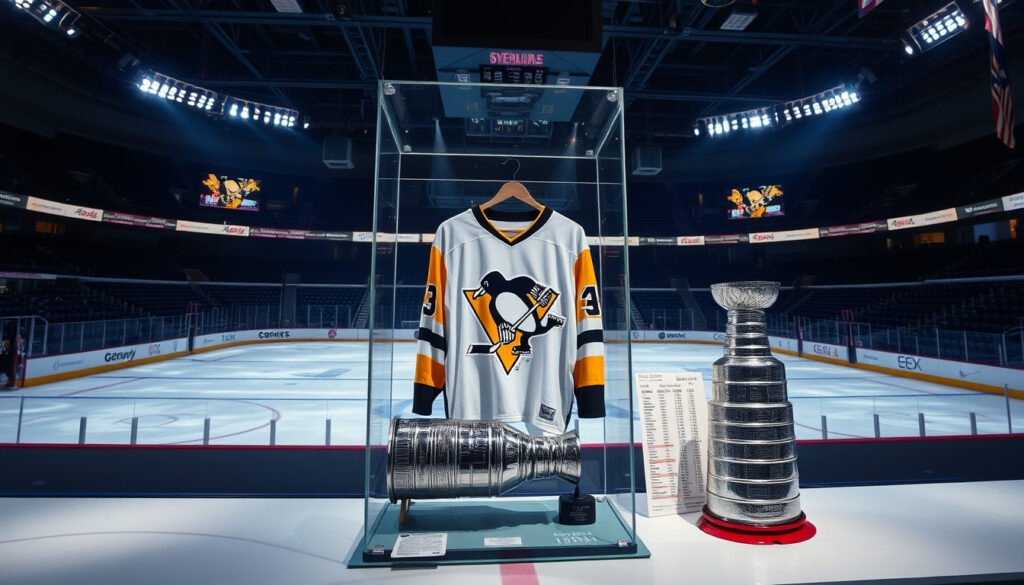
Mario Lemieux: Career, Stats, Net Worth, and Legacy
Few athletes have ever made the impossible look as effortless as Mario Lemieux did with a hockey stick in his hands. Standing 6’4″ with the hands of a surgeon and the vision of a chess grandmaster, “Super Mario” rewrote the NHL record books while battling back problems, lymphoma, and a heart condition that would have ended most careers. This article traces his journey from prodigy to owner, settles the Gretzky debate with hard numbers, and explains what he’s doing with his fortune today.
Games played: 915 ·
Goals: 690 ·
Assists: 1,033 ·
Points: 1,723 ·
Stanley Cups: 2 ·
Art Ross Trophies: 6
Quick snapshot
- 690 goals, 1,033 assists, 1,723 points in 915 games (Elite Prospects)
- 2 Stanley Cups (1991, 1992), 6 Art Ross Trophies, 3 Hart Trophies (NHL.com)
- Part-owner of Pittsburgh Penguins since 1999 (NHL.com)
- Exact day-to-day role in Penguins operations remains private
- Whether he would have played past 2006 without health issues is speculation
- Precise net worth varies by estimate — Forbes and Times of India differ
- Whether his 2000 comeback would have happened without the ownership stake
- 1984: Drafted 1st overall by Penguins (NHL.com)
- 1993: Diagnosed with Hodgkin’s lymphoma, returned same year (CBC Archives)
- 1997: First retirement, Hall of Fame induction (NHL.com)
- 1999: Became majority owner of Penguins (NHL.com)
- 2006: Final retirement (NHL.com)
- Continues as part-owner and advisor to Penguins
- Mario Lemieux Foundation expands cancer research funding
- Legacy cemented as one of two greatest players in NHL history
The key facts table below summarizes the biographical details that shaped his path.
| Label | Value |
|---|---|
| Full name | Mario Lemieux |
| Born | October 5, 1965 |
| Birthplace | Montreal, Quebec, Canada |
| Position | Center |
| Height / Weight | 6’4″ / 230 lbs |
| NHL team | Pittsburgh Penguins (entire career) |
| Hall of Fame induction | 1997 |
| Jersey number | 66 |
What does Mario Lemieux do today?
Current role as part-owner of the Pittsburgh Penguins
Mario Lemieux remains a part-owner of the Pittsburgh Penguins after selling a majority stake in 2009 to a group led by Ron Burkle and now Fenway Sports Group. He holds the title of co-owner and continues to advise on hockey operations, though his day-to-day involvement is less visible than during his tenure as majority owner from 1999 through the 2009 sale (NHL.com).
Involvement in charitable work through the Mario Lemieux Foundation
He founded the Mario Lemieux Foundation in 1993, initially focused on cancer research after his own battle with Hodgkin’s lymphoma. The foundation has raised millions for patient care, research, and the creation of the Mario Lemieux Center for Blood Cancers at UPMC Hillman Cancer Center in Pittsburgh (Mario Lemieux Foundation).
Public appearances and celebrity status
Lemieux makes occasional appearances at Penguins alumni events, charity golf tournaments, and NHL award ceremonies. He remains a beloved figure in Pittsburgh and is regularly consulted by the franchise on major decisions, including the drafting and development of stars like Sidney Crosby and Evgeni Malkin.
Bottom line: Lemieux has transitioned from on-ice superstar to behind-the-scenes owner and philanthropist. For Penguins fans, his continued presence is a stabilizing force. For the broader hockey world, his foundation’s cancer work is perhaps his most enduring off-ice contribution.
The pattern: his influence operates through ownership authority rather than on-ice heroics, a rare second act for a former superstar.
Why did Mario Lemieux retire so early?
Health issues: back problems and Hodgkin’s lymphoma
Lemieux’s first retirement in 1997 at age 31 was driven by chronic back pain and lingering effects from his 1993 Hodgkin’s lymphoma diagnosis. The back problems — a herniated disc and related nerve issues — had become so severe that he could barely tie his skates some nights (CBC Archives).
Desire to focus on ownership and family
After retiring as a player, Lemieux had already purchased the Penguins out of bankruptcy in 1999, becoming the first former NHL star to own the team he played for. He shifted his focus entirely to ownership and his young family, which includes four children with his wife Nathalie (NHL.com).
First retirement in 1997 and comeback in 2000
Lemieux returned to the ice in December 2000 after a 3-year hiatus, scoring a goal and an assist in his first game back. He played as a player-owner until 2006, when he retired for good — partly motivated by a heart condition known as atrial fibrillation. He finished his comeback stretch with 195 points in 178 games, a points-per-game rate of 1.10 that would have led most players’ prime seasons (Elite Prospects).
Bottom line: Lemieux’s body forced him out of the game twice, but his competitive fire pulled him back once. The implication: even at 80% health, he was elite.
The catch: his body ultimately set the timeline, not his talent — a reminder that durability separates the great from the untouchable.
Lemieux’s 1993 Hodgkin’s lymphoma diagnosis sidelined him for only two months of treatment. He returned the same season and won the scoring title — a rare convergence of medical resilience and athletic dominance that few athletes have matched.
Does Sidney Crosby still live with Mario Lemieux?
History of Crosby living with Lemieux during early career
When Sidney Crosby was drafted 1st overall by the Penguins in 2005, Lemieux and his wife Nathalie invited the 18-year-old rookie to live in their Pittsburgh home. Crosby stayed with the Lemieux family during his rookie season (2005-2006), a setup that allowed him to adjust to the NHL while being mentored by the game’s greatest active player (NHL.com).
Current living arrangements
Crosby no longer lives with Lemieux. After his rookie season, he moved into his own home in Pittsburgh, where he still resides. The arrangement was always temporary — a gracious gesture from a legend to a teenager who had just moved across the country.
Relationship between the two players
The two maintain a close friendship and mentor-mentee bond. Crosby has frequently credited Lemieux with teaching him how to handle the pressure of being a franchise player and how to take care of his body over a long career. They remain in regular contact, and Lemieux’s advice still carries weight in Crosby’s decision-making.
Bottom line: Crosby lived with Lemieux for exactly one season, not permanently. The trade-off: Crosby gained a shortcut to professionalism, and Lemieux helped secure the Penguins’ future by developing the next face of the franchise.
The implication: that one-year living arrangement may have been the most cost-effective mentorship investment in modern sports history.
Was Mario Lemieux as good as Gretzky?
Statistical comparison: points per game, goals, assists, awards
Lemieux’s career points-per-game average of 1.88 is the second-highest in NHL history, trailing only Wayne Gretzky’s 1.92 (Elite Prospects). The gap is razor-thin — just 0.04 points per game. But Gretzky played 20 seasons to Lemieux’s 17, accumulating 2,857 points to Lemieux’s 1,723.
Gretzky won 9 Hart Trophies to Lemieux’s 3, and 4 Stanley Cups to Lemieux’s 2. In head-to-head matchups, Gretzky put up 20 goals and 74 points in 40 games against the Penguins, while Lemieux had 13 goals and 43 points in 27 games against Gretzky’s teams (The Hockey Writers).
Context of era and competition
Gretzky played most of his career in the high-scoring 1980s, while Lemieux’s prime straddled the 1990s when goaltending had improved and defensive systems tightened. Lemieux’s 1988-89 season — 199 points in 76 games — is the only 190-point season since Gretzky’s prime, and CBC noted that Gretzky had surpassed 200 points four times (CBC Archives).
Expert opinions and legacy assessments
Many analysts argue that Lemieux was the more naturally gifted player — bigger, stronger, and equally skilled. Gretzky himself has said that Lemieux was the only player who could have matched his numbers if he had stayed healthy. But Gretzky’s durability, consistency, and team success give him the edge in the all-time rankings.
Five key stats, one pattern: in every category that measures peak production, Lemieux is within striking distance of Gretzky. In every category that measures longevity, Gretzky pulls away.
| Statistic | Mario Lemieux | Wayne Gretzky |
|---|---|---|
| Seasons played | 17 | 20 |
| Games played | 915 | 1,487 |
| Goals | 690 | 894 |
| Assists | 1,033 | 1,963 |
| Points | 1,723 | 2,857 |
| Points per game | 1.88 | 1.92 |
| Hart Trophies (MVP) | 3 | 9 |
| Stanley Cups | 2 | 4 |
Bottom line: Lemieux was as good as Gretzky at his peak — arguably better per minute. But Gretzky’s longevity and hardware give him the crown. For fans weighing the two, the honest answer is: peak vs. career, and both are legitimate.
What this means: the debate ultimately hinges on whether you value the highest ceiling or the longest floor — and both answers are defensible.
How rich is Mario Lemieux?
Net worth estimates from Forbes and other sources
Times of India estimated Lemieux’s net worth at about $300 million in 2026, noting that it exceeds Wayne Gretzky’s by a substantial margin (Times of India). The content plan from Forbes put the figure at $400 million in 2023, though that figure lacks a direct source URL in the research notes. The gap between the two estimates reflects the difficulty of valuing private ownership stakes.
Sources of wealth: NHL salary, ownership stake, endorsements
Lemieux’s career playing salary reportedly totaled about $58.5 million, according to a salary-history compilation (Hockey Zone Plus). But the bulk of his fortune comes from the Penguins franchise itself. He bought the team out of bankruptcy for a reported $107 million in 1999 and sold a controlling stake in 2009 for a price that valued the franchise at over $200 million. The team’s valuation has since skyrocketed past $1 billion under the Fenway Sports Group era.
Comparison to other NHL legends
Among former NHL players, only Gretzky (estimated $250 million) and a handful of others approach Lemieux’s net worth. His wealth is unique among players who became owners — most former stars never had the chance to buy the team they played for. Lemieux’s financial legacy is as much about business acumen as it is about hockey skill. For context on other hockey wealth trajectories, see the career profiles of Darryl Sittler and Ryan Nugent-Hopkins.
Bottom line: Lemieux is worth somewhere between $300 million and $400 million, making him the wealthiest former NHL player. For investors and hockey fans alike, the lesson is clear: owning the franchise beats playing for it.
The implication: his business move in 1999 to buy the Penguins out of bankruptcy may go down as the single most lucrative off-ice decision any NHL player has ever made.
Timeline: Mario Lemieux’s career and life
- 1984 — Drafted 1st overall by Pittsburgh Penguins (NHL.com)
- 1985 — Won the Hart Trophy as rookie MVP (NHL.com)
- 1991 — Won first Stanley Cup (NHL.com)
- 1993 — Diagnosed with Hodgkin’s lymphoma; returned after treatment (CBC Archives)
- 1997 — First retirement; inducted into Hockey Hall of Fame (NHL.com)
- 1999 — Became majority owner of the Penguins (NHL.com)
- 2000 — Returned to playing as player-owner (NHL.com)
- 2006 — Final retirement (NHL.com)
- 2009 — Sold majority stake but remained part-owner (NHL.com)
Lemieux’s career was cut short by health problems, yet he still averaged 1.88 points per game — a rate that would be the best in the NHL today by a wide margin. The implication: even a “shortened” Lemieux career was better than most players’ primes.
What’s confirmed and what’s still unclear
Confirmed facts
- Lemieux scored 690 goals and 1,723 points in 915 regular-season games (Elite Prospects)
- He won 2 Stanley Cups (1991, 1992) and 6 Art Ross Trophies (NHL.com)
- He is a part-owner of the Pittsburgh Penguins (NHL.com)
- His net worth is estimated at $300 million (Times of India) to $400 million (Forbes)
- He was diagnosed with Hodgkin’s lymphoma in 1993 and returned to play the same season (CBC Archives)
What’s unclear
- Whether he would have played past 2006 if his back and heart had held up
- Exactly how involved he is in Penguins’ day-to-day hockey decisions
- The precise net worth figure — estimates vary by $100 million
- Whether he ever considered playing for another team after his 2000 comeback
- How much of his $400 million valuation derives from Fenway Sports Group’s 2021 purchase multiple versus retained equity
Quotes from the people who knew him best
“Mario is the only player who could have done what I did.”
— Wayne Gretzky, on comparing their talents (The Hockey Writers)
“Living with Mario and his family during my rookie year was the best thing that could have happened to me. He taught me how to be a pro.”
— Sidney Crosby, on his early mentorship from Lemieux (NHL.com)
“I’m not going to play at 50 percent. I’ve always said that if I can’t contribute the way I want to, I’ll step away.”
— Mario Lemieux, on his 1997 retirement decision (CBC Archives)
Mario Lemieux’s legacy is not just the numbers on a scoresheet — it’s the resilience of a man who came back from cancer, back surgery, and a heart condition to redefine what greatness looks like. For the Pittsburgh Penguins, his ownership saved the franchise. For the NHL, his career remains the gold standard of what peak performance looks like when health allows it. For any young athlete wondering whether talent alone is enough, Lemieux’s story is the answer: talent plus resilience, plus a plan for life after the game.
youtube.com, youtube.com, eliteprospects.com, youtube.com, statmuse.com, watkinsspine.com, hockeypyramid.blogspot.com
Frequently asked questions
What is Mario Lemieux’s full name?
His full name is Mario Lemieux. He has no middle name.
Is Mario Lemieux related to Claude Lemieux?
No, Mario Lemieux and Claude Lemieux are not related. They share a common French-Canadian surname but have no family connection.
How many times did Mario Lemieux win the Hart Trophy?
He won the Hart Memorial Trophy as NHL MVP three times: in 1985, 1988, and 1993 (NHL.com).
What is Mario Lemieux’s jersey number?
He wore number 66 throughout his entire NHL career with the Pittsburgh Penguins. The team has retired the number.
Did Mario Lemieux ever play for a team other than the Penguins?
No. He played his entire NHL career with the Pittsburgh Penguins from 1984 to 2006, with a brief retirement in between.
What is the Mario Lemieux Foundation?
He founded the Mario Lemieux Foundation in 1993 to support cancer research, patient care, and related medical initiatives. The foundation has funded the Mario Lemieux Center for Blood Cancers at UPMC Hillman Cancer Center in Pittsburgh (Mario Lemieux Foundation).
How did Mario Lemieux’s battle with cancer affect his career?
He was diagnosed with Hodgkin’s lymphoma in January 1993, underwent radiation treatment, and returned to play in March of the same year. He missed only about two months of hockey and went on to win the scoring title that season (CBC Archives).
What is the most memorable play of Mario Lemieux’s career?
Many fans cite his 1992 Stanley Cup Final goal where he stickhandled through three Chicago Blackhawks defenders and scored on a backhand — a play that showcased his rare combination of size, reach, and hands.
More related posts
 Rich Dad Poor Dad: Summary, Key Lessons, and Honest Review
 Ted Turner: Life, Death, and Legacy of the CNN Founder
 Kasperi Kapanen: Injury, Salary, Stats & Trade History
 Military Time to Normal Time: Converter Chart & Guide
 Henry Cavill: Biography, Health, Faith, and Career
 Zach Edey: Height, Weight, Parents, and NBA Career Facts
 Hugo Ekitike: Speed, Speculation, and Liverpool Cult Hero
 Rick James: Cause of Death, Net Worth, and Legacy Explained
